
Why you can run the room but not stand in front of it
You can chair any boardroom and still freeze at the podium. Why public speaking fear in otherwise capable leaders is not about the speaking. It is being seen.

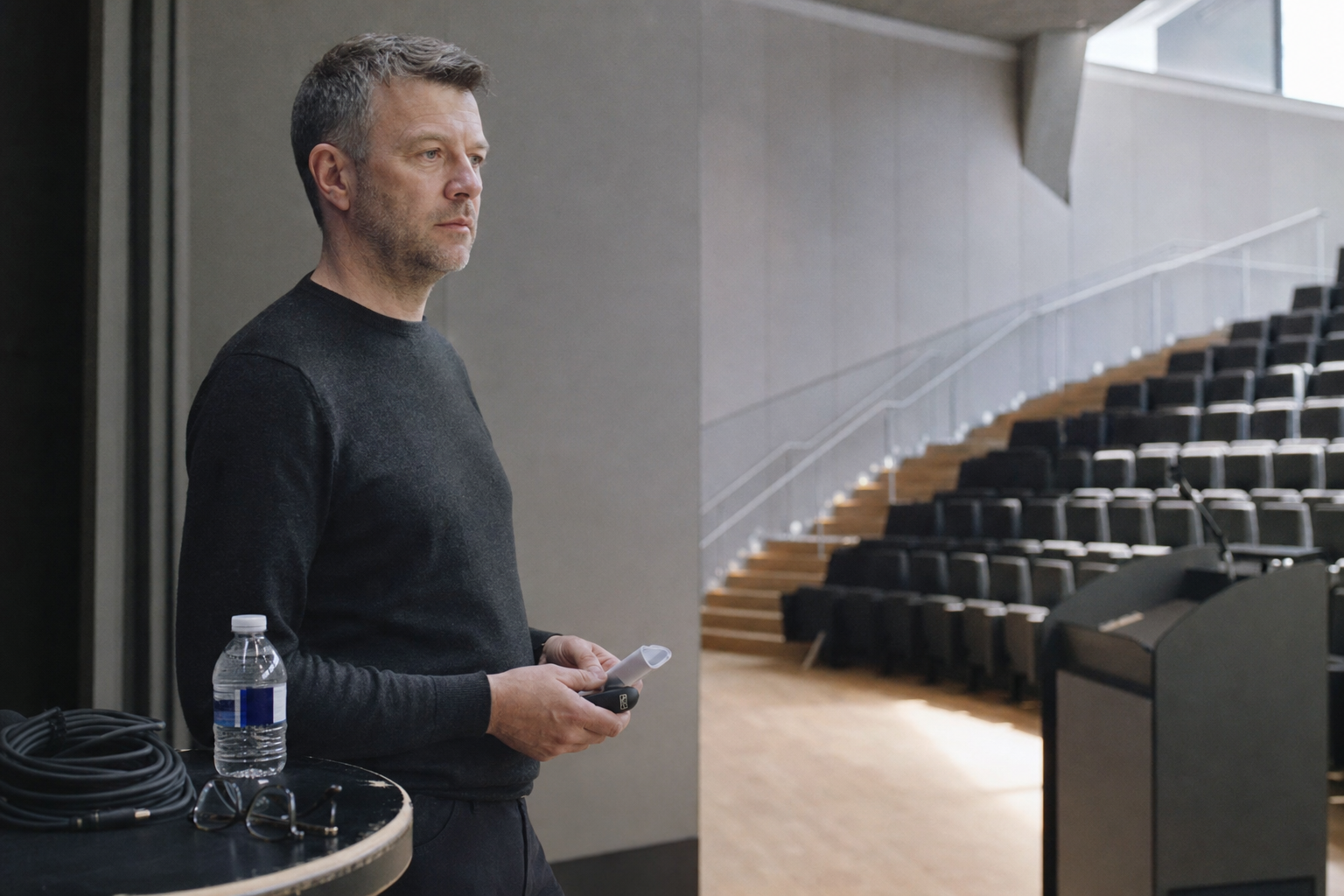
You can chair a board meeting without a flutter. You can deliver bad news to a room of people who depend on you and hold every eye while you do it. You can take a hostile question and turn it without raising your voice.
Then someone asks you to stand at the front and present, and something else takes over.
The slides are ready. You know the material better than anyone in the building. And still, the night before, your stomach turns. The morning of, your hands go cold. You stand up, and for the first few minutes you are not really there. You are watching yourself speak from somewhere behind your own eyes, waiting for it to be over.
You have decided this is a flaw. A strange gap in an otherwise capable person. You run a company and you cannot do the thing a teenager does in a school assembly. You think, “I lead hundreds of people and I cannot do this.” So you avoid it where you can, and white-knuckle it where you cannot, and tell no one.
It is not the speaking. It is being looked at.
Watch where the fear actually lives. Not in the chairing. Not in the difficult conversation. Not in the negotiation where the stakes are real and the room is against you. All of those you handle. The fear lives in one specific place: standing still, in front of people, while they look at you and you are not in control of what they see.
That is the tell. The common factor in everything you can do is that you have a role to play and a job to perform. The common factor in the thing you cannot do is that, for a moment, the role falls away and there is just you, on display, being assessed.
Most people call this stage fright and treat it as a skills problem. Learn the techniques. Breathe from the diaphragm. Picture the audience in their underwear. Practise until it is automatic. The advice assumes the problem is the performance, and that a smoother performance will fix it. It will not, because the performance was never the problem. You can present flawlessly and still feel the dread. Plenty of polished speakers do, every week, and tell no one that either.
What you call stage fright, your body calls exposure.
The rule your body learned
Somewhere early, being looked at came with risk. Maybe you were the child held up as an example and made to perform for the adults. Maybe you were the one laughed at once, in front of everyone, at an age when that lands like a wound. Maybe attention in your house was never neutral. It arrived as scrutiny, or as judgement, or as the warmth that could be taken away the moment you got something wrong.
The body learned a rule. Being watched is dangerous. Stay useful, stay in role, stay in motion, and you are safe. The danger is in being still and seen with nothing to do.
That rule has run quietly ever since. It is why you are fine the moment there is a function to perform. Chairing is doing. Answering is doing. The hostile question is a problem to solve, and solving keeps you safe. But standing at the front with the floor to yourself is not doing. It is being. And being looked at, with no task to hide behind, is the exact situation the old rule was built to protect you from.
The adrenaline, the cold hands, the sense of watching yourself from the back of the room: that is not nerves about the talk. It is a threat response firing on schedule, triggered not by the audience but by the configuration. Still body. Many eyes. No role.
This is why the techniques do not reach it. Breathing exercises and rehearsal work on the surface, on the delivery, on the part of you that reads instructions. The trigger sits underneath all of that, in a system that decided long before you had words that exposure equals danger. You can rehearse a talk a hundred times and the body will still read the moment the same way, because you have changed the script and left the alarm untouched.
I work with senior leaders who can hold a boardroom and fall apart at a podium, and who cannot understand the gap in themselves. People who lead hundreds, who make decisions other people would not sleep through, who go quietly cold at the thought of a keynote. Underneath it is almost always the same thing. Not a confidence deficit. A nervous system that learned, a long time ago, that being seen without a job to do was the most dangerous place to stand. The work is not more rehearsal. It is finding where that rule was set, and changing it at the level it was made.
What changes when being seen stops being dangerous
When it shifts, the change is not that you become a brilliant speaker. You may already be one on the outside. The change is that the inside catches up. You stand at the front and the floor does not drop. The eyes on you stop reading as a threat and start reading as what they are: people, listening, mostly on your side.
The dread before the event eases first. You stop losing the night before. Then the first few minutes change. You are in them, rather than watching them from somewhere behind your eyes. The adrenaline still comes, because some of it is useful and always will be. It just stops being terror wearing the mask of preparation.
You were never bad at speaking. You were bracing against being seen.
Most of all, the avoidance goes. The talks you used to engineer your way out of. The visible roles you quietly declined. The platform you told yourself you did not want. You stop arranging your professional life around a fear you no longer have to manage, and a great deal of energy comes back that was going into the managing.
If you can run any room in the building and still freeze in front of one, the problem is probably not your speaking and it was never your nerve. It is that some part of you still believes being looked at, with nothing to do but be yourself, is the most dangerous place you can stand. It is not. It has not been for a very long time. The part of you that flinches just never got the message.

Subscribe to our newsletter


