Why the second wind arrives around eleven at night
Sleep trouble is common in adults with ADHD. Two evening habits give a fast mind a finish line, and I explain where they stop working and what I do then.

The second wind that arrives around eleven at night has a cause. It is the first hour of the day in which nobody needs anything from you.
Until then the day is claimed. The van, the customers, the quotes, the toddler, the phone going off in your pocket. Then the house goes quiet and your mind, held at half speed since six, finally runs at the speed it was built for.
That speed is a strength. In adults with ADHD it comes with quick pattern spotting, invention, and the ability to hold a whole job in your head at once: the circuit, the materials, the order of work. I call ADHD a superpower that needs managing, and a wind at eleven is the superpower turning up on the wrong shift.
Sleep trouble is very common in adults with ADHD, and a later body clock is a frequent finding. So the pull towards midnight has a body behind it as well as a mind.
Give the night shift a finish line
The first thing to do tonight is write down tomorrow's first three jobs, on paper, at a fixed time. Half past eight suits most evenings with a small child in the house. Three jobs, where you need to be first, and what goes in the van. Then close the notebook, put it by your keys, and treat it as shut.
Paper matters because a phone has a search bar, and the search bar is how one price check becomes forty minutes of angle grinders. The fixed time matters as much as the list. A mind learns an edge by meeting it at the same hour.
This works because your mind keeps tomorrow open when it does not trust that it is held anywhere else. Most people tell me they are afraid of losing the good ideas that come at that hour, and the notebook answers that fear directly. Once the list exists outside your head, the watch has nothing to do.
Write tomorrow down on paper and the night shift has nothing left to guard.
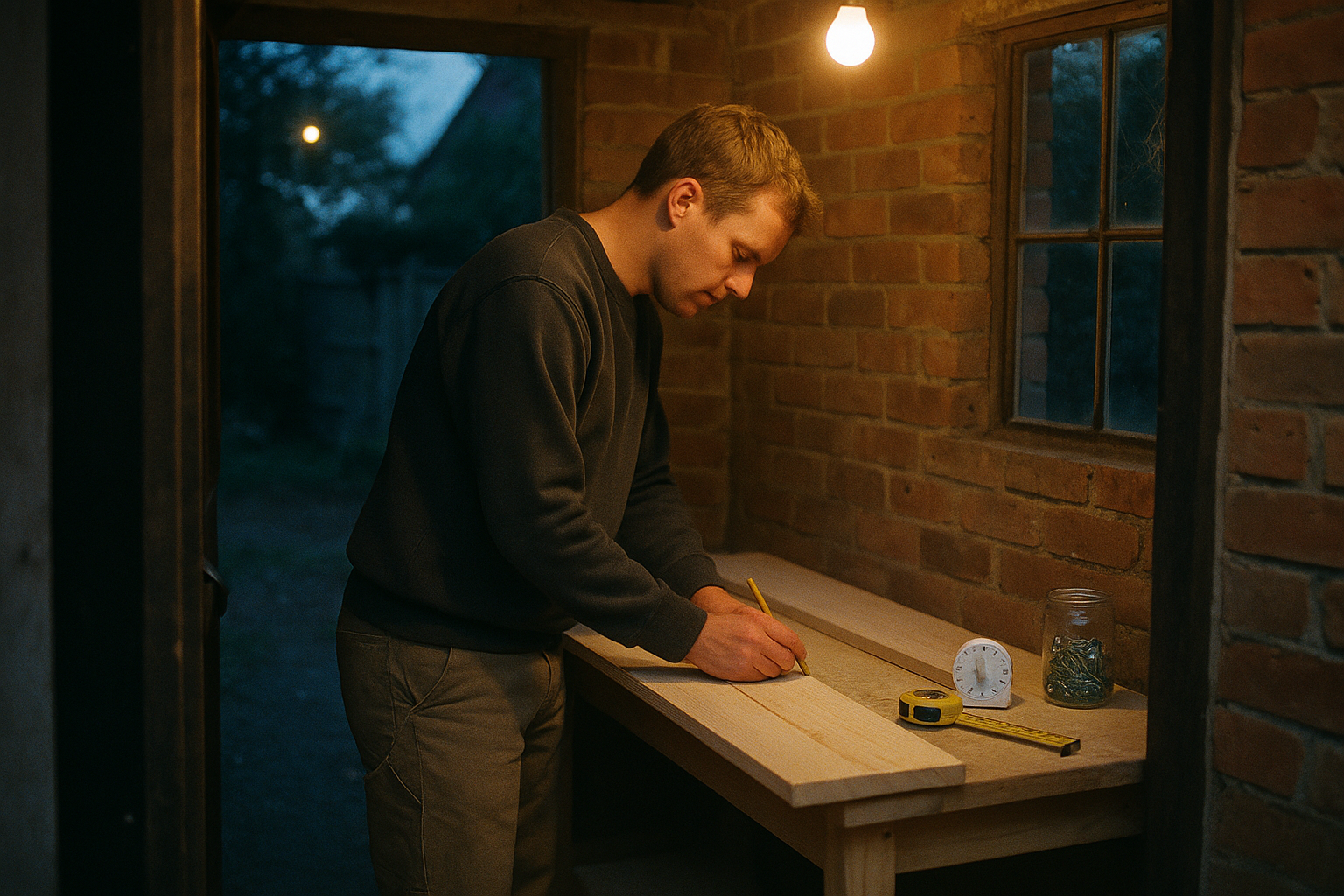
The second thing is to move the good hour earlier. Around half past seven, once the toddler is down, give the fast, absorbed part of your mind something finite and engaging, with a clear stop. Drawing up a loft layout for a quote, building a shelf for the van, sorting the stock list. Forty minutes, a timer you can hear, and a finished state you can point at.
The finite part is the whole trick. Hyperfocus needs somewhere to go, and an open search for the best impact driver has no bottom. Give the speed a job with an end and it spends itself there, so by eleven there is less of it left to keep you up.
Stop on the timer even when it is going well. That is the hardest part, and the part that teaches the mind the edge.
Where these stop working
Both of these work when the racing comes from the evening you have had. They stop working when it is a pattern that fires by itself. You write the list, close the notebook, lie down, and the planning starts anyway, at the same hour, with nothing left to plan. Six o'clock comes round the same as ever.
By then the body has learned the hour. It runs the planning the way it runs a morning routine, without asking you.
By then the wind is a habit of the body, and no list reaches a habit that no longer runs on the jobs.
The other case comes up most weeks. Years of being told to calm down, to switch off, to just stop thinking, from teachers, a parent, a partner. Every night you lay awake and failed became another small proof, and now the bed itself carries the shame. Lying there trying to switch off sets the whole thing going.
That is where my work starts. With clinical hypnotherapy I find when the night racing began, what it does for you, and what it keeps watch over, and I change what happens when your head meets the pillow.
The speed stays. The hour stops firing on its own.
Where a specific memory carries the shame, I use EMDR, a method that reprocesses one memory at a time with guided eye movements, so the memory keeps its facts and loses its charge. People tell me the first change is that the good hour starts turning up before ten, when it is some use to them.
Until then, the notebook at half past eight costs five minutes, and it is worth keeping to on the evenings it feels pointless.

Subscribe to our newsletter