When a twinge turns into a two-hour search
Health anxiety is rarely about the body. It is about what happens when not knowing feels dangerous, and why reassurance stops holding within the hour.

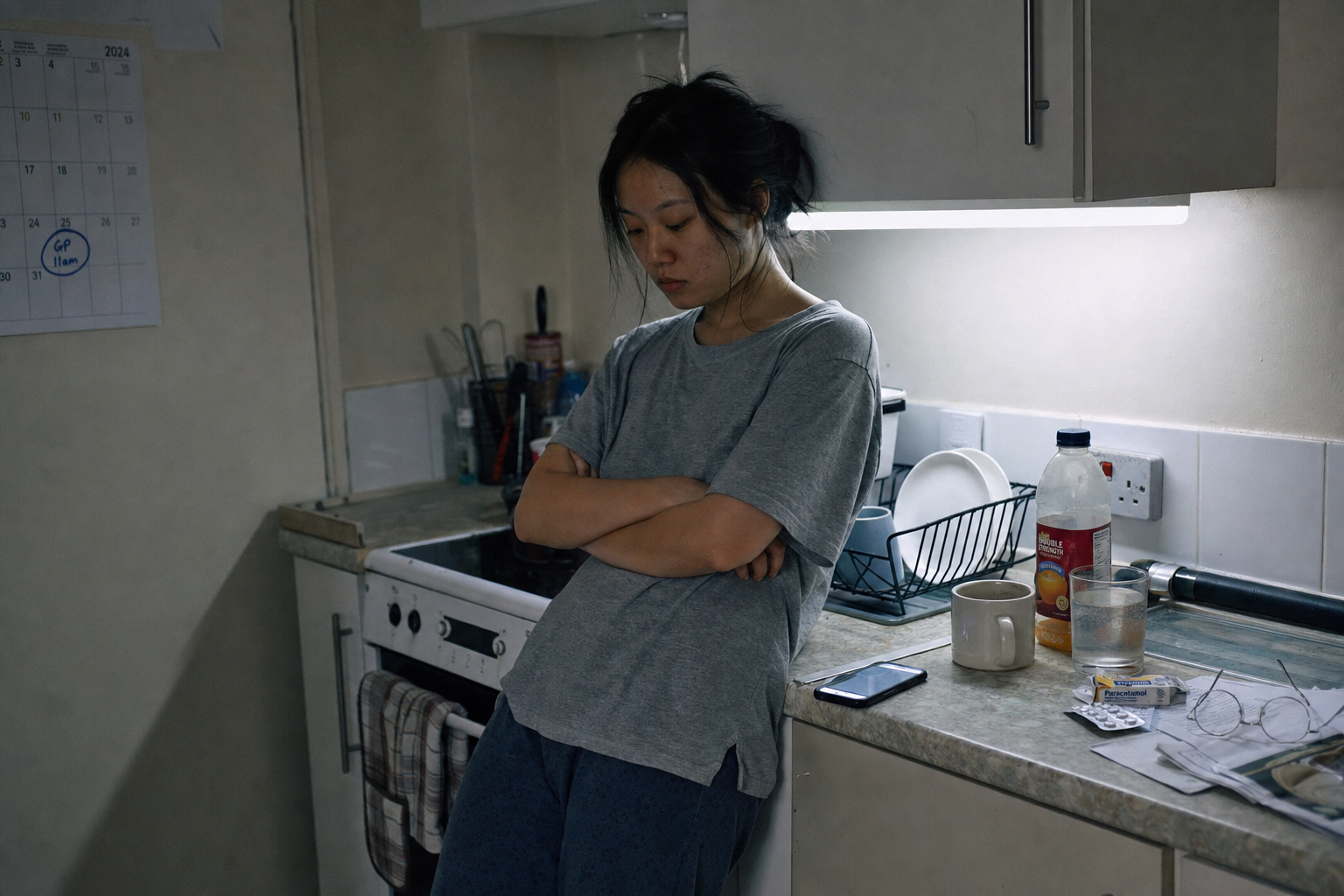
Most days it does not happen. Then a headache runs into a second afternoon, or a mole looks slightly different under a different light, and by nine in the evening you have four tabs open and a word in your search history you had never heard of on Monday.
You know how this goes. You have done it before, more than once, and it has never once ended with you feeling better.
The first ten minutes are almost calm. You are gathering information. Then somewhere around the third page the tone changes, and you are not reading to find out any more. You are reading until you find the sentence that lets you stop.
It never quite arrives. Something is always slightly qualified. Rare, but. Usually harmless, though. So you go back.
By midnight you have either booked an appointment or talked yourself out of booking one, and either way you lie there going over the reasoning again.
In the morning it is smaller. Not settled. Just quieter, the way most things are quieter at eight in the morning. That is the part that makes it hard to take seriously, because by lunchtime it looks like an odd evening rather than a pattern.
I work with people who can tell you the exact odds. They have read the studies. They know the base rate for their age and their family history, and none of it touches the thing that starts up at nine in the evening.
Uncertainty is the part most people skip past. A twinge on its own is nothing much. A twinge that might mean something, with no way of settling which, is a different object entirely, and your system treats the second one as a live problem that has to be finished tonight.
Some people can hold that gap open. They notice the sensation, register that they do not know, and get on with the evening. The not-knowing sits there without escalating. For you it does not sit. It presses.
So you go looking for certainty, because certainty is the only thing that would make the pressing stop. Search results are very good at looking like certainty. That is what makes them so hard to leave. Every page gives you a version of an answer, and every version is close enough to be worth reading and incomplete enough to send you to the next one.
The search is never finished. It is only interrupted.
The same shape shows up in the reassurance you get from people. You ask your partner to look at it. You get seen, and the person seeing you is kind and unbothered and tells you it is nothing. For about forty minutes you are fine.
Then it wears off, and you notice you are already assembling the next question. This is the bit people find humiliating, and it is the most ordinary part of the whole thing. Reassurance that stops holding within the hour is not evidence that you are ungrateful or difficult. It is evidence that it never reached the thing it was aimed at.
There is usually a history underneath it, and it is rarely dramatic. Somebody in your family got ill and nobody saw it coming. Or you spent part of your childhood in a house where a parent's health set the temperature of the week, and you learned to read a face for bad news before you could read a book. Or your own body did something frightening once, at fourteen or at thirty, and nobody ever properly explained it to you.
Whatever the version, the conclusion drawn underneath is the same. Bodies do not give you warning. Attention is the only thing standing between you and the thing that arrives without any.
That conclusion was reasonable when it was made. It has simply never been asked to check itself since.
By the time it has been going on for a few years it has become a pattern that has outlasted every attempt to talk yourself out of it, and that record tends to get read as proof the thing is permanent. It is proof of nothing except that the attempts were aimed at the wrong level.
The standard advice knows some of this. Stopping the searching, deleting the symptom tracker, holding a fixed window for the worrying and keeping the rest of the day out of it: all of that reduces how often this happens, and for a lot of people it reduces it considerably. It is worth doing and it is not the enemy.
What it does not do is change the reading. You can hold the line for six weeks, and then something genuinely new turns up in your body, and the whole apparatus is back inside an evening, because nothing underneath ever concluded anything different. The behaviour got managed. The alarm did not.
That is why it survives so much effort. A worry that runs the same loop every evening is not a discipline problem, and treating it as one mostly adds shame to a list that was already long enough.
Effort is not in short supply here. Most people doing this are trying extremely hard, and have been for years, at the only level anyone has offered them.
Talking about it helps more than people expect and less than they hope. Being properly listened to about the fear takes the isolation out of it, and the isolation is a real part of the weight. It does not, by itself, retrain what your body does with a sensation at nine in the evening.
When the not-knowing stops registering as danger, the checking has nothing to do. You notice a twinge and you notice it and it goes nowhere. Not because you talked yourself down from it. Because there was no climb.
Appointments then get made on their merits. You go when something warrants going. You do not go when it does not. Neither decision costs you an evening.
What people tend to report first is not relief. It is the strangeness of having had a symptom for three days and only remembering on the Thursday that it was there.
The last thing to go is the habit of checking whether it has gone.

Subscribe to our newsletter