Why you go blank when you already know the answer
You knew it an hour ago, then your mind went blank in the exam. The blank is not a memory failure. It is your body treating the test as a threat to survive.

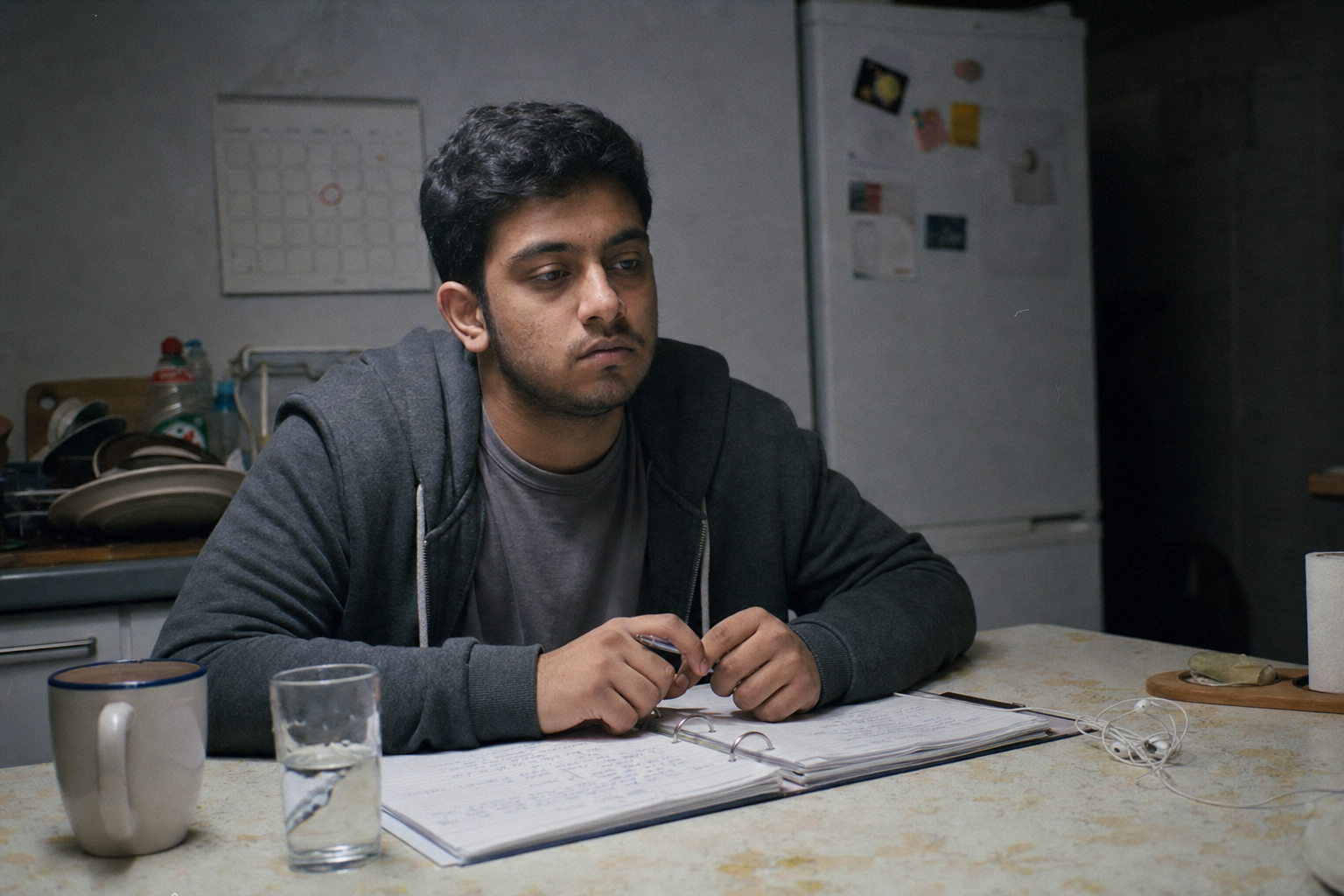
You sit down. The paper lands in front of you. The first question is one you have answered a hundred times, in the kitchen, on the bus, halfway through making the dinner. You read it. Nothing comes.
The words are familiar. The answer is not there.
It happens at the driving test. At the trade assessment. At the resit you swore would be the last one. It happens in the interview, on the exact question you rehearsed in the car on the way in. An hour ago the material was solid. You could have recited it to anyone who asked. Now there is a clean white space where it used to be, and the clock is running, and the harder you push the wider the space gets.
The blank is not a memory failure. Nothing has been deleted. The information is sitting exactly where you left it. Something has moved in front of it.
Why the answer disappears
When a moment reads as a threat, the body does what it has always done. It moves resources towards survival. Attention and blood pull away from the part of the brain that reasons and recalls, and towards the part that scans for danger. The recall machinery is still loaded. It has simply stopped being the priority.
Your body has quietly decided that getting through the next ten minutes matters more than the third point on a list you learned last week. So it shuts the door on the list. Not to punish you. To protect you. It is doing the same thing it would do if a car swerved towards you on a crossing, except there is no car, only a desk and a page and a part of you that has decided this counts as life or death.
You feel it in the body before you understand it. The heart goes first. You read the same line three times and none of it lands. You skip to a question you definitely know and that one is gone too now. The page starts to look like a list of things you have never seen. None of that is stupidity. It is a nervous system doing exactly what it was built to do, at the worst possible time.
That is why the answer comes back the second you walk out. The threat is over. The system stands down, the door opens, and there it is, whole and obvious, as though it had been waiting in the corridor the entire time. It had.
It is not that you did not know it. It is that the knowing was switched off at the exact moment you needed it.
This is the part most people cannot make sense of. You did the work. You can prove you did the work everywhere except the one room that counts. So you reach the only conclusion that seems to fit. The problem must be the work. And you go and do more of it.
I work with people who have sat the same test three and four times, who can give every answer in every setting except the one that matters. The work goes to the place where the test got welded to something much bigger than a subject, and takes that join apart, so the moment stops reading as danger.
Because more revision aimed at a body that is treating the test as a threat is just more weight on a problem that was never about weight. You can know the material cold and still go blank. The block is not in how much you learned. It is in what your body believes is riding on the result.
What the blank is really guarding
For a lot of people the exam stopped being an exam a long time ago. It quietly became a verdict. Pass, and you are capable, you keep up, you are not the one who gets left behind. Fail, and something you have always been a little afraid might be true gets confirmed, in writing, with a date on it.
The body does not score the test. It scores the meaning. And a verdict about whether you are good enough is not a question to be answered. It is a danger to be survived. The system cannot tell the difference between a multiple-choice paper and a threat to your standing in the world, because you taught it, somewhere along the way, that they were the same thing.
That is the load. Not the content. The content was never heavy. The thing it got attached to was.
It usually builds early. A test you failed in front of people who laughed. A parent whose face changed at a grade. A teacher who read the marks out and let the room go quiet. Somewhere back there the result stopped being information about a subject and became information about you. The body kept the rule long after you forgot the afternoon it learned it. And every test since has been quietly graded against that old verdict, not the one on the paper.
So the advice to relax misses. The advice to breathe misses, mostly. You cannot talk a nervous system out of a threat it genuinely believes in. Telling someone to stay calm while their body is braced for a verdict is like telling a smoke alarm to be quiet while the kitchen fills with smoke. The alarm is not the problem. It is reading something as fire. The work is changing what gets read as fire.
When that changes, the test changes with it. Not the content of it. The charge underneath it.
The body stops treating the room as a threat, and the door stays open. Same revision. Same questions. Same hard chair and ticking clock. The difference is that the recall is no longer being overridden by a part of you watching for a danger that is not in the room. You read the first question and the answer is simply present, the way it was on the bus, because nothing is pulling your attention away to keep you safe from a page.
People expect to walk in feeling confident. Mostly they just feel ordinary, and then accurate. The nerves do not have to disappear, and they will not entirely. A little adrenaline sharpens recall. It is the flood that closes the door, and the flood comes from the meaning, not from the maths.
The first question is still one you can answer. It always was. The work is teaching the body that answering it is allowed to be safe.

Subscribe to our newsletter