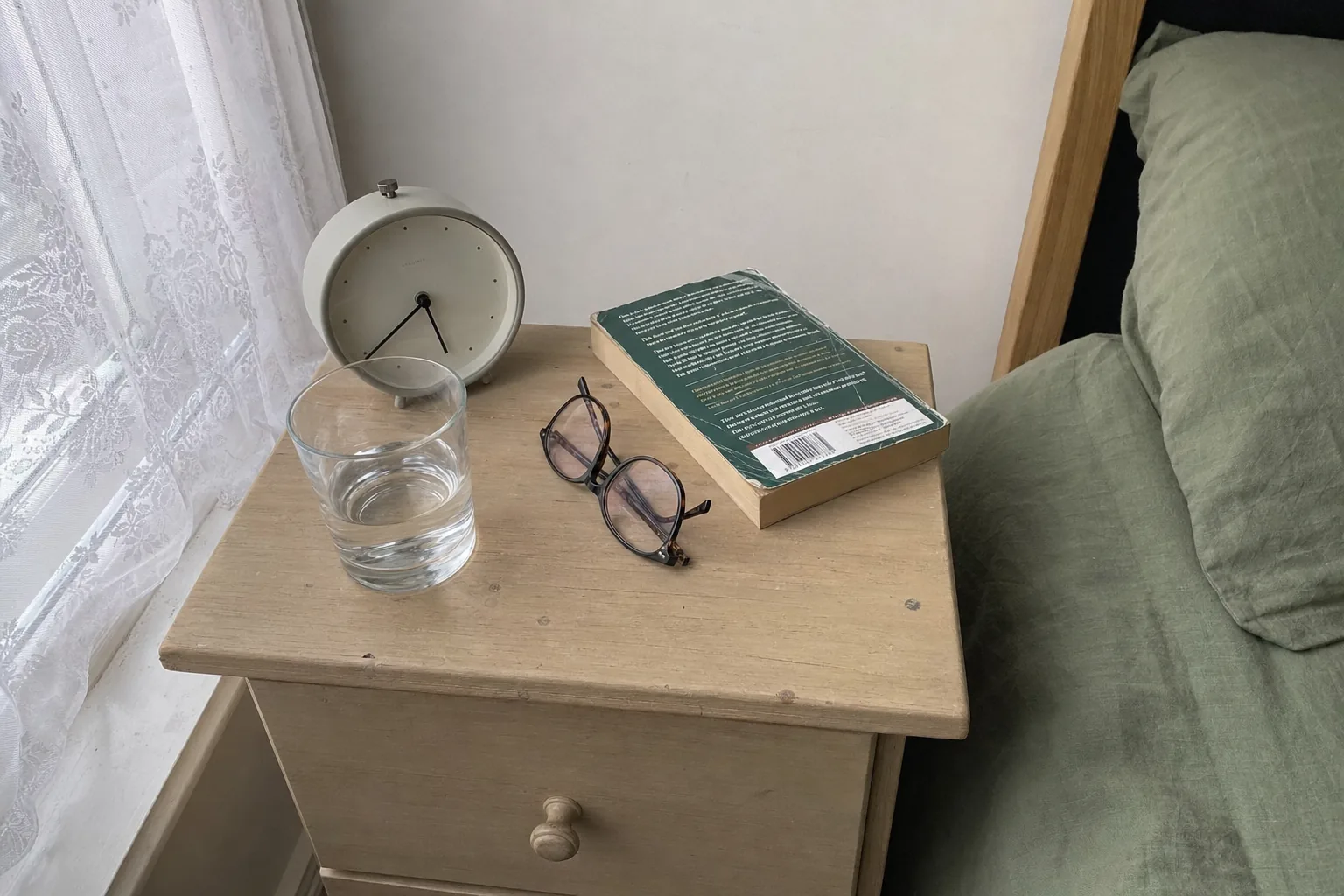
How to stop overthinking at night
A written list after tea, and getting out of bed once you have been awake about twenty minutes. Why both work, and what to do when the loop is years old.


To stop overthinking at night, do two things. Write down tomorrow's jobs earlier in the evening, and get out of bed when the loop starts instead of lying there fighting it.
Both are backed by sleep research, though the studies are small.
You are asleep by eleven. At ten past three you are awake, going through a quote you have not priced, a supplier who is late again, and the way a conversation with your daughter ended. Nothing is asking for your attention at that hour, and the house is quiet. Your head fills the gap.
All day the phone, the customers and the job in front of you keep the unfinished business waiting. At night it gets its turn.
Write the handover before you go up
Do it at the kitchen table after tea, not in bed. Take five to ten minutes, a pen and a sheet of paper. Write what has to happen tomorrow, as specifically as you can: "ring the timber merchant about the oak before nine", not "sort suppliers".
In the sleep studies on this, people who wrote a specific list of what needed doing fell asleep faster than people who wrote nothing. They also did better than people who wrote out what they had already done. The list works because it gives your head a place to put things down.
The loop is your head holding everything in case you forget. Put it on paper and it can let go.
Most people tell me they will remember it all, which is exactly the job the three o'clock version of them is trying to do. The list is usually shorter than they expected, under ten lines. The line that matters most is the one they want to leave off: the awkward call, the conversation with the daughter, written down as one small first step.
This is also the answer to how to not think about work in the evening. When you run the firm there is no clocking off, so the list is the clocking off.
How to stop worrying once you are already awake
Do not try to push the thoughts away. Trying hard to force a thought off tends to make it louder.
The standard advice in sleep treatment, and I give it to nearly everyone in the first session, is to get up once you have been awake and stewing for around twenty minutes. A rough sense of the time is enough, and turning the clock to face the wall helps.
Sit somewhere dim and do something dull: a paper catalogue, the radio low. Not your phone. Go back to bed when you are sleepy.
The reason is the bed. Lie there worrying for an hour a night and the bed learns that this is what it is for. Getting up breaks that link.
If you lie there worrying for an hour a night, the bed learns that is what it is for.
People tell me they dislike this advice more than any other. "I'll be wrecked tomorrow" is the usual reply. The first few nights are the worst, and after that lying awake in bed stops being the default.
When the loop is years old and keeps coming back
For a loop that began in a bad few weeks, a list and a chair are often enough. Try them for a fortnight and see what changes.
Some loops are older than the business. Same hour, same pull, a different subject each month. It comes back after a holiday, and it was there before this quote, this supplier, this daughter. You cannot reason it down at three in the morning, because the part that runs it does not take instruction from the part that knows it is pointless.
That is how you train your brain to stop overthinking: you change the habit underneath.
This is the work I do. I take a history and ask when the waking started and what it was keeping watch for. It usually began long before any quote.
Then I use clinical hypnotherapy, behaviour pattern reprogramming at the level beneath conscious thinking, where the habit of keeping watch lives, so the alarm stops going off at the same hour. I give no timeline, because people differ.
If your sleep has been poor for months, or your mood has dropped very low, see your GP as well. Keep the list and the chair either way. They sit comfortably alongside the rest.
I see people at my practice near Maidstone, Kent, and online. Most tell me the first thing to change is how quickly they go back to sleep after waking.

Subscribe to our newsletter