Sober curious gets it right, up to a point
Sober curious got a lot right about drinking. But counting the units never quite reaches what the drink is actually doing for you at the end of the day.

Something has shifted around drinking, and most of it is a good shift.
More people are looking at the glass in their hand and asking what it is actually there for. Sober curious. Mindful drinking. Dry January that stretched into a dry spring and never quite ended. A generation coming up that drinks a fifth less than the one before it. Whole bars now serving nothing stronger than a tonic and a slice of lime. For a long time, not drinking marked you out. Now it barely turns a head.
A lot of this is worth having. The old story was that you either drank like everyone around you or you had a problem, and there was nothing in the space between. That left a large group of people with no words for their own experience. Not dependent. Not in crisis. Not comfortable either. The sober curious idea handed them a way to look at their drinking without first having to stand up and call themselves an alcoholic. That matters more than it sounds. Shame keeps people drinking far better than it ever stopped anyone.
And it is honest about nuance. It does not ask you to hit some rock bottom or swear off drink for the rest of your life. It lets you ask a smaller, truer question. Is this adding anything. Most people, asked plainly, already half know the answer.
Here is where it tends to stop, though.
The whole conversation is built around the drinking itself. How much, how often, how deliberately. Count the units. Swap the wine for a zero percent. Notice your triggers and plan around them. All sensible. All aimed squarely at the behaviour.
But for a certain kind of drinker, the behaviour was never really the thing.
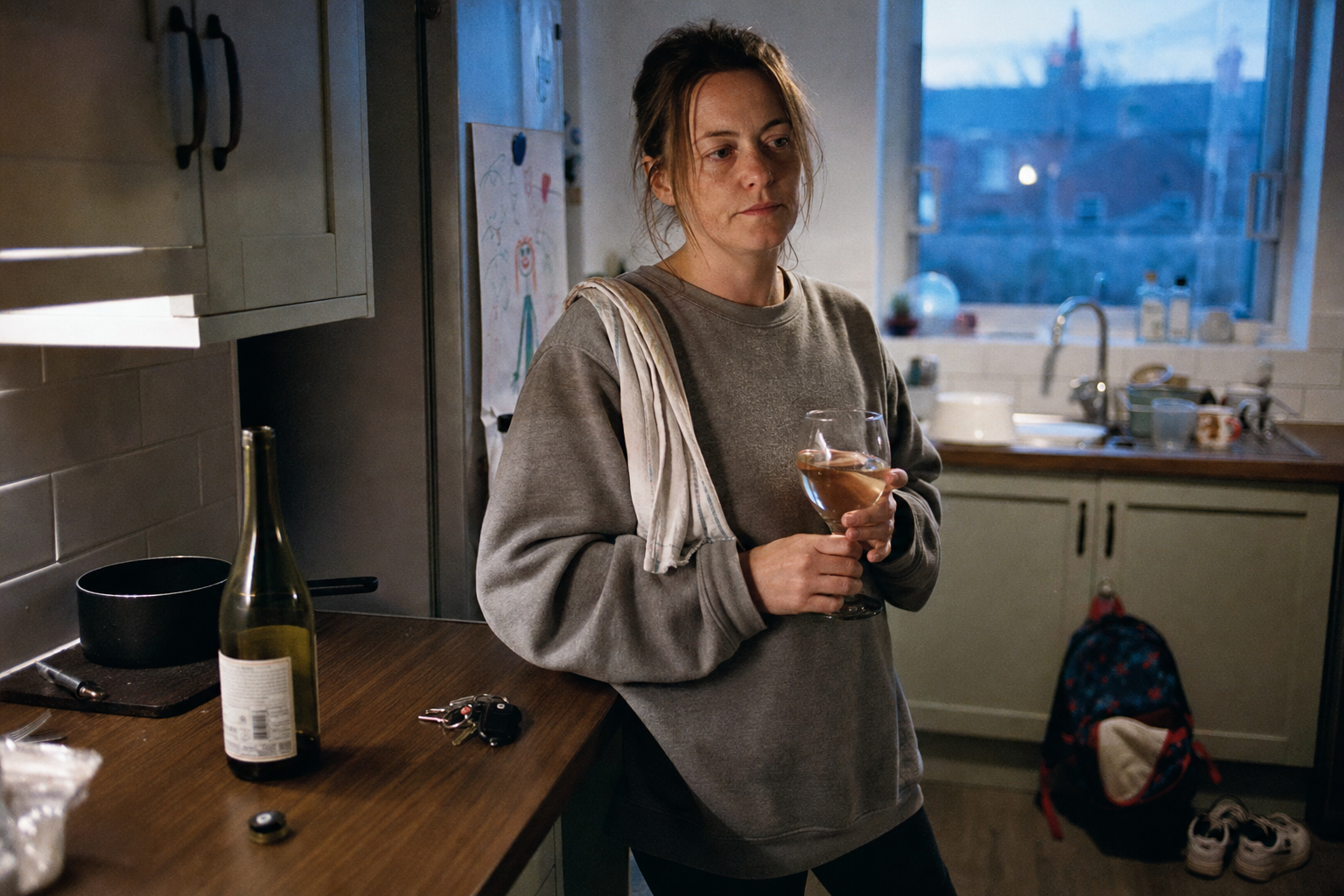
You are not drinking to get drunk. You are drinking to change the temperature of the evening. The day has been loud in your head, and the first drink turns the volume down. Your shoulders come off your ears. The knot behind your ribs loosens by a notch. For twenty minutes you are not braced against anything, and you had not realised how braced you were until it stopped.
That is not a fondness for wine. That is a job the drink is doing, and it is doing it well. Which is exactly the trouble.
It did not start as a crutch. It started as a treat. A wind-down. The thing you had earned after a long day. Nobody sits down and decides to make a drink load-bearing. It happens by repetition. The evenings got harder, the drink got a little more necessary, and somewhere along the way the small reward quietly turned into the thing holding the day together.
When you set out to drink less by willpower, by tracking, by keeping the fridge empty, you take away the tool without touching the thing it was managing. The stress is still there at six o'clock. The flatness is still there on a Sunday afternoon. The loneliness has not gone anywhere. You have simply removed the one reliable way you had of putting all of it down for an hour.
So the counting holds for a while. Then a hard week arrives and it does not. You are back where you started, with a fresh layer of failure sitting on top. Not because you lack discipline. Because the drink was answering a question nobody had actually named.
You know the shape of it. The resolve in the morning, clear and certain. The slow erosion across the afternoon. The small negotiation with yourself around teatime, the one you always win because you had half decided before it started. Then the same quiet disappointment the next day, a little heavier than the last. It is not a lack of wanting to change. You want it every single morning.
I work with people who have tried every version of drinking less and cannot understand why none of it sticks. They are not weak and they are not in denial. They are quietly medicating something they have never put a name to. Grief they moved past too fast because life did not pause to let them feel it. A level of daily worry they long ago mistook for their personality. A marriage that went silent years back and never got spoken about. Once that thing is found and dealt with at the root, the drink tends to loosen its grip on its own. Not through gritted teeth. It just stops being needed.
This is the part the sober curious conversation rarely reaches. Cutting down is a behaviour. What sits underneath the drinking is not. You can manage a behaviour with rules and apps and good intentions. You cannot manage a feeling into going away. You can only meet it.
For some people the honest answer really is less. Fewer nights, smaller measures, drink kept back for the occasions that genuinely mean something. Harm reduction is real and it helps a great many people, and none of this argues against it. For others, where drinking has tipped into real dependence, the right move is proper support, and there is no shame in that door either. Both of those are true, and both matter.
The point is narrower than it sounds. If drinking is how you cope, then managing the drinking without touching what you are coping with is only ever going to be a holding action. You can drink mindfully and still be reaching for it every evening at six, more mindful about the reach but no freer from it.
So drink less if less is what you want. It may be exactly the right call, and for plenty of people it is the whole story. But watch what happens around six o'clock on the evenings you have decided not to. If something in you goes looking for the glass before you have even chosen to have one, pay attention to that. Not the number of units. The reach itself.
That reach is the real information. Everything worth changing is sitting underneath it.

Subscribe to our newsletter